
Subscriptions

IFRS 9 macroeconomic scenarios for expected credit loss modelling

Independent baseline, upside and downside forecasts with evidence-based probability weights. Built on our proprietary stress testing model and the expert judgement of award-winning economists, every scenario is audit-ready and designed for both regulatory requirements and business planning.

Download the brochureTalk to our team

London City skyline

What is IFRS 9?

IFRS 9 is the international accounting standard for financial instruments. Published by the IASB in July 2014 and effective since 1 January 2018, it replaced IAS 39 and covers classification and measurement, impairment and hedge accounting. IFRS 9 requires institutions to measure expected credit losses (ECL) using forward-looking information, rather than relying on historical loss experience alone. In practice, that means building probability-weighted macroeconomic scenarios into their ECL models. Getting that right demands both rigorous economic forecasting and the credibility to stand behind it with auditors and regulators. Capital Economics provides independent, trusted insight to help you navigate these complexities with clarity and confidence.

Economic insight

Why does IFRS 9 need macroeconomic scenarios?

“Expected credit losses (ECL) must be an unbiased, probability-weighted amount that reflects a range of possible outcomes, not just the most likely one. Because credit losses tend to rise faster in a downturn than they fall in an upturn, a single central forecast usually understates them. Most lenders therefore use a small set of representative scenarios, each with a probability weight. That is what we provide

How we support IFRS 9 expected credit loss modelling

Our IFRS 9 macroeconomic scenario service combines forward-looking scenario probabilities, proprietary stress testing models, clear narratives and the expert judgement of our award-winning economists to deliver scenarios you can confidently use for both regulatory requirements and business planning. Our analysis and forecasts are independent, and we are a trusted provider of insights to the financial sector, with a strong track record of accuracy awards from organisations including LSEG and FocusEconomics.

A range of outcomes

IFRS 9 asks for a range of possible outcomes. We deliver up to six scenarios, from Strong Upside (90th–95th percentile) to Extreme Downside (2nd–5th).

Probability weighting

Each outcome needs a weight. Ours come from a fan-chart distribution built on our forecast track record, adjusted by our UK Economic Risk Index.

Current forecasts

ECL must reflect conditions at each reporting date. We update quarterly, in real time during volatile periods, and review at every reporting date.

Our scenario framework 

What’s in our IFRS 9 scenario set?

Up to six scenarios, each anchored to a percentile of the distribution of plausible outcomes. The baseline is our modal forecast, the single most likely path, close to the 50th percentile in neutral conditions. Prefer your own set? You choose the number of scenarios, their names and the probability each represents.

Every scenario comes with variable paths, a probability weight, a concise narrative and audit-ready documentation.

ScenarioPercentile
Strong Upside (U2)90th-95th
Mild Upside (U1)70th-80th
Baseline (BL)Modal forecast (around the 50th)
Moderate Downside (D1)20th-30th
Severe Downside (D2)7th-12th
Extreme Downside (D3)2nd-5th

Who it's for

Who uses our IFRS 9 scenarios?

Banks and lenders

Banks, building societies and specialist lenders that need independent, probability-weighted scenarios they can defend to auditors and regulators.

International portfolios

Lenders outside the UK or with multi-country exposures, with scenarios built for the markets in your portfolio.

Corporates and beyond

Our scenarios aren’t just for regulatory reporting. Corporates use them for business planning and stress-testing their strategy.

Methodology

How we build and weight IFRS 9 scenarios

Our baseline forecasts are built on detailed analysis of economic data, historical context and evolving relationships within a robust analytical framework, rather than relying solely on large-scale econometric models. This approach allows us to clearly explain the drivers of our forecasts, including the impact of one-off events. Our economists combine statistical techniques with experience and expert judgement to derive the baseline, with senior economists regularly reviewing and challenging the outlook to identify new trends and reassess assumptions as conditions evolve.

01

Stress testing economic model

Our scenarios are produced using proprietary stress testing models, built in-house and underpinned by economic theory. Shocks propagate in line with expected economic relationships, keeping every scenario internally consistent.

02

Upside and downside scenarios

A suite of scenarios complements our baseline, spanning upside and downside outcomes across a range of severities. Each comes with a concise, jargon-free narrative and clearly defined assumptions, tailored to your portfolio.

03

Measuring uncertainty

We map the range of plausible outcomes around our baseline using a fan chart, the approach the Bank of England uses to show forecast uncertainty. Calibrated to more than 25 years of our own forecast errors, it sets each scenario’s severity.

04

Economic Risk Index

Our proprietary Economic Risk Index combines indicators of business sentiment, household confidence, financial conditions and housing expectations. It adjusts the width of the bands and the balance of risks, and is reviewed at every reporting date.

The senior team behind your scenarios

Paul Ashworth

Paul Ashworth

Chief Data & Modelling Economist

Paul Ashworth is the Chief Data & Modelling Economist at Capital Economics. He joined CE in 2001 from the National Institute of Economic and Social Research (NIESR), where he worked on developing their macroeconometric model of the world economy (NiGEM), after taking degrees in Economics and Mathematics at Strathclyde University (BSc) and Warwick University (MSc) and completing a PhD on asymmetric adjustment in macroeconomic models.
Alexandra-Dreisin

Alexandra Dreisin

Head of Modelling

Alexandra Dreisin is Head of Modelling at Capital Economics, where she leads the firm's quantitative modelling work, including the design and development of macroeconomic models for IFRS 9 and CECL scenario frameworks. Prior to this role, she spent over 10 years on the Consultancy team. Before joining Capital Economics in 2014, she was a research analyst at macro investment firm SLJ Macro Partners, and prior to that an economist at the US Bureau of Labor Statistics specialising in quantitative analysis and seasonal adjustment of the Consumer Price Index.
Paul Dales

Paul Dales

Chief UK Economist

Paul Dales is our Chief UK Economist, with overall responsibility for our analysis and forecasts of UK Economics and UK Housing. Paul joined Capital Economics soon after it was founded in 1999 and has previously been our Chief Australia & New Zealand Economist and Senior US Economist. In 2022, he led the team that was named UK Economics Forecaster of the Year by the Sunday Times. Paul regularly writes articles for the London Evening Standard and frequently appears on TV and radio.
Grant Colquhoun

Grant Colquhoun

Chief Consultancy Economist

Grant is Chief Consultancy Economist and since joining Capital Economics in January 2018 has led due diligence, scenario planning and advocacy projects covering a range of countries. In previous roles he was Group Economist at a leading mining and metals consultancy, headed Oxford Economics sectoral forecasting service and held economist positions at HM Treasury and British Steel. Grant has extensive experience of the Chinese economy and in analysing and forecasting economic sectors internationally.

Why Capital Economics

Why choose Capital Economics for IFRS 9 scenarios?

Our modelling team partners with financial institutions to transform the complexities of IFRS 9 into clear, defensible and commercially robust solutions. The teams are fully integrated with our award-winning UK Economics team, whose internally produced baseline forecasts and ongoing peer review ensure that our IFRS 9 work is grounded in robust, independently validated macroeconomic thinking.

Meta logo

“We’re now fully integrating Capital Economics’ risk scores into our internal reporting for monthly collectability assessments under US GAAP and IFRS. We fully trust the quality of Capital Economics’ service and look forward to continuing and expanding our strategic partnership with the CE team.”

Global Credit Risk Data Solutions, Meta Platforms

Capital Economics IFRS9 modelling scenarios

The IFRS 9 guide

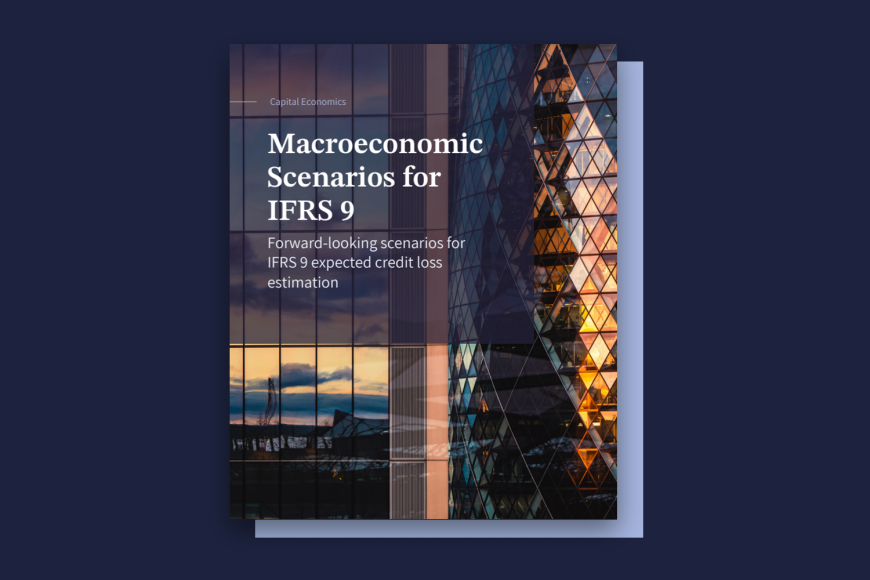
Download the IFRS 9 scenarios brochure

Navigating the complexities of IFRS 9 demands more than compliance – it requires a scenario framework that is robust, auditable and fit for the specific risk profile of your institution.

Our IFRS 9 scenarios are developed by our specialist modelling team, drawing on input from expert economists across Capital Economics. They are grounded in economic theory and sound statistical principles, aligned with regulatory expectations and designed to withstand scrutiny from auditors and supervisors alike. Our brochure sets out the full service, from scenario design and probability weighting to what you receive at each reporting date.

Download the brochure Talk to our team

Contact us

Explore IFRS 9 scenarios with our team

Tell us about your portfolio, models and reporting timetable, and our modelling team will be in touch.


Prefer email? sales@capitaleconomics.com

Indicates required field
Country

FAQ

IFRS 9 scenarios: your questions answered

IFRS 9 Financial Instruments is the IASB's accounting standard for financial instruments, effective since 1 January 2018. It replaced IAS 39 and introduced the expected credit loss model for impairment.

A probability-weighted estimate of credit losses (the present value of expected cash shortfalls), weighted by the risk of default. Lenders typically estimate it with probability of default (PD), loss given default (LGD) and exposure at default (EAD) models.

Any entity reporting under IFRS, including UK firms using UK-adopted IFRS. Banks are most affected, but corporates must also apply it, for example to trade receivables.

Stage 1: no significant increase in credit risk, so 12-month ECL. Stage 2: a significant increase in credit risk, so lifetime ECL. Stage 3: credit-impaired, so lifetime ECL, with interest calculated on the net carrying amount.

Both require expected credit losses. IFRS 9 uses a three-stage model and explicitly requires probability-weighted outcomes. CECL, the US GAAP standard, requires lifetime losses from day one and doesn't mandate multiple scenarios.

Forecasts of economic conditions, such as unemployment, under a baseline and alternative outcomes. Each has a probability weight. Lenders run them through their credit models to estimate expected credit losses.

IFRS 9 sets no number. It requires a range of possible outcomes, but not every possible scenario (B5.5.42). Our default framework has up to six, and you can choose fewer.

Weights are applied after the scenarios are built, so they don’t affect the scenario paths. Our recommended weights start from a balanced set, with the largest weight on the baseline and equal weight on comparable upside and downside outcomes. We adjust them when our Economic Risk Index signals a material shift in the balance of risks. Alternatively, you can tell us the weights you want to use.

IFRS 9 requires ECL to reflect information available at the reporting date, so forecasts must be current at each one. We update quarterly, and in real time during volatile periods.

Yes. Forward-looking information also informs whether credit risk has increased significantly (5.5.9). That decides whether a loan carries 12-month or lifetime expected losses.

Yes. You choose the number of scenarios, their names and the percentile each is anchored to, and we build them on the same model. You can also set your own probability weights or use ours.

Get in touch

Ready to strengthen your IFRS 9 scenarios?

Speak to our consultancy team about scenarios tailored to your portfolio and reporting timetable.

 Contact us